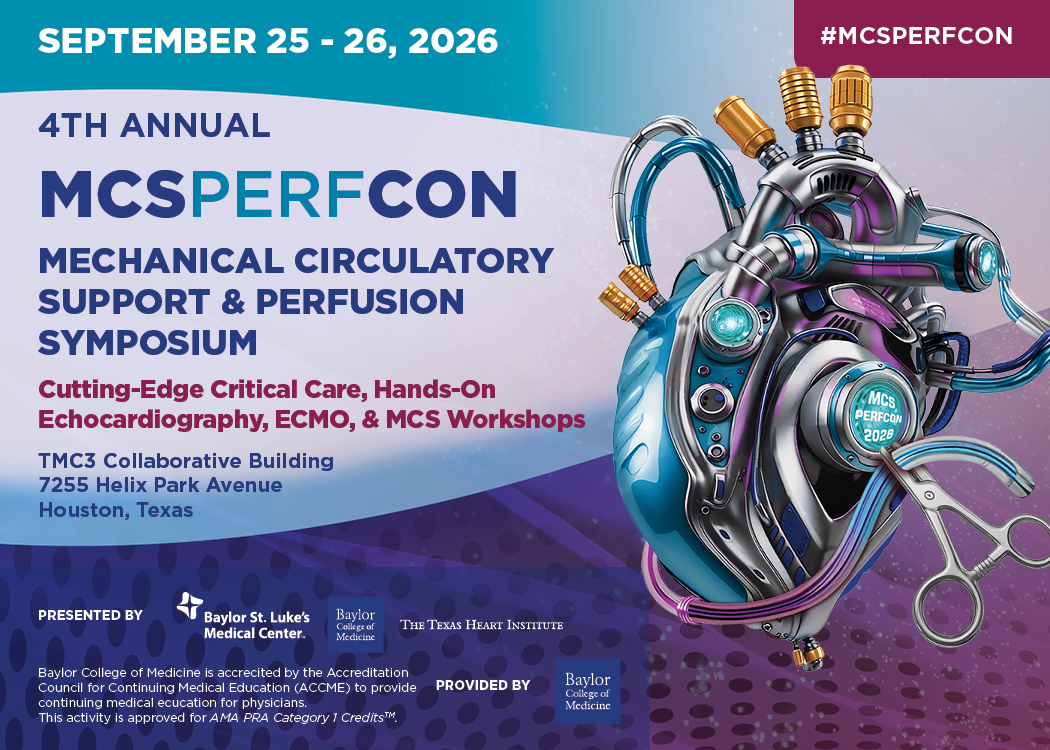
September 25, 2026 - September 26, 2026
TMC3 Helix Park
7255 Helix Park Ave, Houston, TX 77030
In-person Conference with virtual option
Needs Statement
Despite substantial advances in mechanical circulatory support (MCS), extracorporeal membrane oxygenation (ECMO), and perfusion science, meaningful gaps remain between evidence-based best practices and their consistent application in perioperative and critical care settings.
Current Clinical Challenges
- Device decision-making: Timely selection, escalation, troubleshooting, and weaning of MCS modalities, including IABP, Impella, VA/VV/VAV ECMO, ventricular assist devices, and total artificial hearts
- Advanced perfusion strategies: Variability in experience with goal-directed perfusion, cerebral and organ protection during cardiopulmonary bypass, and perfusion management during complex aortic, congenital, transplant, and TAH procedures
- Evolving standards of care: Gaps in clinician readiness for donor organ preservation, donation after circulatory death (DCD), and normothermic regional perfusion (NRP)
Educational Priorities
Clinicians need targeted education that reinforces physiologic principles and supports real-time clinical decision-making across the perioperative MCS and perfusion continuum, including:
- Shock recognition and phenotyping
- Optimization of oxygen delivery and organ protection through goal-directed perfusion
- Selection and management of appropriate MCS and ECMO configurations
- Integration of evolving organ preservation and normothermic regional perfusion techniques
Hands-On and Team-Based Training
- HANDS ON: ECMO, ECHO & Mechanical Circulatory Support Workshop
- Simulation-based training to build technical skill and confidence in high-risk scenarios such as cannulation, circuit failure, recirculation, ventricular distention, differential hypoxia, transport, and device-related complications
- Interdisciplinary communication and team-based workflows to improve coordination, reduce practice variability, and enhance outcomes for patients requiring advanced mechanical circulatory support
Target Audience
This activity is designed for
- physicians,
- fellows,
- residents,
- perfusionists,
- advanced practice providers,
- nurses,
- medical students, and
- any clinician managing critically ill patients on mechanical circulatory support or advanced perfusion support.
Learning Objectives
At the conclusion of the conference, participants should be able to:
- Recognize, phenotype, and manage cardiogenic and respiratory shock, including determination of when to escalate to mechanical circulatory support.
- Select and apply the most appropriate device (i.e., Intra‑Aortic Balloon Pump (IABP), Impella, Veno‑Arterial/Veno‑Venous/Veno‑Arterio‑Venous Extracorporeal Membrane Oxygenation (VA/VV/VAV ECMO), Ventricular assist devices (VADs), or total artificial heart) based on patient needs.
- Implement goal-directed perfusion to protect the brain, kidneys, and heart during complex cardiac surgery.
- Execute donation after circulatory death (DCD) and transplant workflows using the latest organ preservation and normothermic regional perfusion (NRP) techniques.
- Demonstrate effective troubleshooting, cannulation, weaning, circuit management, and team communication skills.
Educational Methods
Lecture, Small group breakout session, Panel discussion, Case study, Skill-based training workshop
Activity Evaluation
Evaluation by questionnaire will address program content, presentation, and possible bias.
 Facebook
 X
X LinkedIn
 Forward